Railway Embankment Reinforcement with Geogrid Retaining Wall
Release time:2026-01-04 Click:33
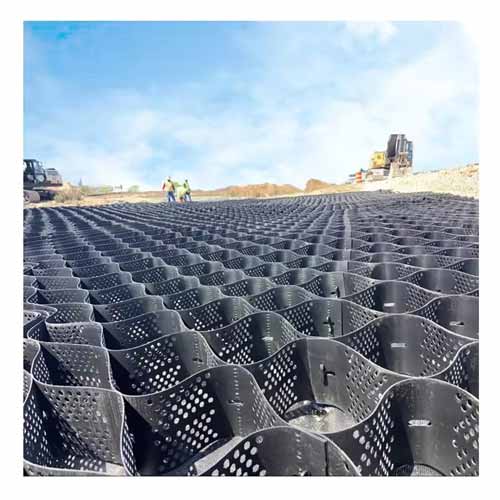
Reinforcing railway embankments with geogrid retaining walls is an advanced geotechnical engineering technique used to stabilize slopes, support vertical walls, and manage loads in challenging ground conditions. This method is crucial for constructing railways on weak soils, steep terrain, or in areas with limited space, ensuring the long-term stability and safety of the track and infrastructure.
A geogrid is a geosynthetic material made from high-density polyethylene (HDPE) or polyester, formed into a grid-like structure with large apertures. Its function is to interlock with the surrounding soil, creating a stable, reinforced soil mass. When used to reinforce an embankment, layers of geogrid are placed horizontally within the soil fill as it is compacted. The soil fills the grid apertures, and the resulting interlock creates a coherent block of reinforced earth that is much stronger and more stable than the native soil alone. This allows for the construction of steeper, more compact embankments than would otherwise be possible.
For retaining walls, geogrids are used to stabilize the backfill soil behind the wall facing (which can be concrete panels, wrapped facing, or other materials). The geogrid anchors into the retained soil, providing tensile strength to resist the lateral pressure and prevent the wall from overturning or sliding. This system is highly effective, cost-efficient, and flexible, allowing it to accommodate some ground movement without catastrophic failure. By using geogrid reinforcement, engineers can build safer, more durable railway embankments and retaining walls, even in the most difficult soil conditions.
Previous article:The Role of Geogrids in Slope Stabilization Projects
Next article:Steel-Plastic Composite Retaining Wall Reinforcement Geogrid for Heavy-Duty Slopes
Hot products
Mobile: +86 15097722953
Email:metalproducts2021@163.com
Email:1755383270@qq.com