How Geocell Systems Transform Soil Engineering
Release time:2026-01-07 Click:34
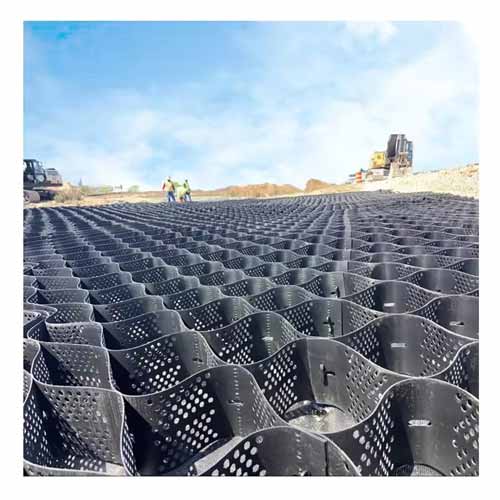
Geocell systems represent a significant advancement in soil stabilization technology, providing three-dimensional confinement that dramatically improves the load-bearing capacity of weak soils while reducing the material requirements and environmental impact of traditional ground improvement approaches. These cellular structures, typically manufactured from high-density polyethylene strips that are expanded on-site to form honeycomb-like panels, create a composite system that distributes loads across a wider area while preventing the lateral movement of aggregate infill that would otherwise migrate into weak subgrades under traffic loads. The development of geocell technology has enabled construction on terrain that would otherwise require extensive excavation and replacement or costly deep foundation systems, providing engineers with practical solutions for applications ranging from unpaved road construction to erosion control on steep slopes.
The engineering principles underlying geocell performance address the fundamental challenges of building on weak or unstable soils by providing confinement that prevents the particle rearrangement and migration that leads to settlement and failure under load. When a geocell panel is expanded and filled with granular material, the three-dimensional confinement prevents the outward movement of aggregate that would occur under traffic loads, effectively creating a stiff composite mat that distributes loads over a wider area than the same aggregate would provide in unconfined applications. The cell walls provide tensile resistance that the granular infill lacks, creating a composite system with flexural stiffness that bridges weak spots in the subgrade and prevents the progressive shear failure that unconfined aggregate experiences under repeated loading. The depth and configuration of cells can be specified to match the subgrade conditions and anticipated loads, with deeper cells providing greater stiffening effect for more demanding applications.
The applications of geocell systems span numerous civil engineering contexts where soil stabilization provides practical and economic advantages over alternative approaches. Unpaved road construction and improvement represents a major application category, with geocell panels reducing aggregate requirements by 50 percent or more while providing improved performance and reduced maintenance compared to conventional unpaved road construction. Slope protection applications utilize geocell panels filled with topsoil and vegetation to create stable, erosion-resistant surfaces on slopes that would otherwise require armoring with more expensive concrete or stone treatments. Retaining wall applications use geocell panels stacked in stepped configurations to create gravity walls that accommodate differential settlement and provide drainage through the granular fill, eliminating the pore water pressure concerns that plague conventional retaining wall systems. Parking lots, storage yards, and other paved areas constructed over weak subgrades benefit from geocell reinforcement that reduces base course thickness requirements while improving long-term performance by preventing subgrade intrusion into the aggregate base.
Previous article:The Long-Term Performance Benefits of Geogrid
Next article:Your Blueprint for Slope Stabilization: Erosion Control Fiberglass Geogrid
Hot products
Mobile: +86 15097722953
Email:metalproducts2021@163.com
Email:1755383270@qq.com