Product details description
The integration of geogrid reinforcement within retaining wall systems
represents a fundamental advancement in earth retention technology that has
enabled the construction of stable earth structures with improved economics and
enhanced performance compared to traditional retaining wall approaches.
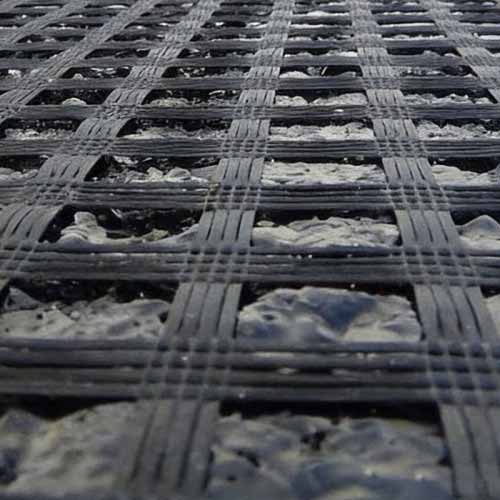
Geogrids, consisting of high-strength polymer meshes or grids manufactured from
materials such as polyester, polypropylene, or glass fiber, function as tensile
reinforcement elements that distribute loads and improve the overall stability
of reinforced soil masses. When incorporated into retaining wall constructions,
geogrids create mechanically stabilized earth systems where the combined
performance of the soil, reinforcement, and facing elements exceeds what any
component could achieve independently. Understanding the principles of geogrid
reinforcement and the design approaches for geogrid-reinforced retaining walls
enables engineers to implement these systems effectively across the diverse
applications where earth retention is required.
The fundamental mechanism of geogrid reinforcement involves the transfer of
tensile stresses from the soil mass to the geogrid reinforcement through
soil-geogrid interaction at the contact surfaces between these materials. As
loads are applied to the retained soil, the resulting lateral earth pressures
generate tensile stresses in the geogrid reinforcement that are anchored through
friction and interlock with the surrounding soil. The development of adequate
reinforcement length beyond the potential failure surface provides the anchorage
necessary to resist pullout forces and maintain system stability. The stiffness
and strength characteristics of the geogrid, as well as the spacing and
orientation of reinforcement layers, determine the effectiveness of load
distribution and the overall stability of the reinforced soil mass. The polymer
materials used in geogrid construction provide excellent durability in soil
environments, with resistance to chemical attack, biological degradation, and
the long-term creep deformation that could compromise reinforcement performance
over the service life of the retaining wall.
The design of geogrid-reinforced retaining walls follows established
engineering principles that address internal stability, external stability, and
the interaction between the reinforced soil mass and the overall slope or wall
system. Internal stability design determines the required geogrid strength,
spacing, and length based on the soil properties, wall geometry, and applied
loads, ensuring that the reinforcement system can resist the tensile stresses
generated by retained earth pressures. External stability analysis addresses the
potential for overall sliding, overturning, and bearing capacity failure of the
reinforced soil mass as a unit, considering the soil properties of both the
reinforced zone and the retained soil. Connection design between geogrid
reinforcement and wall facing elements must provide adequate transfer of forces
while accommodating the movement and deformation that occur as the wall is
loaded. Design standards and specifications, including those published by
AASHTO, FHWA, and the International Building Code, provide frameworks for
geogrid-reinforced wall design that ensure adequate factors of safety and
compliance with applicable regulatory requirements.
The construction of geogrid-reinforced retaining walls requires careful
attention to material handling, placement procedures, and quality control
measures that ensure the installed reinforcement achieves the performance
assumed in design calculations. Geogrid materials must be protected from damage
during storage, handling, and installation, with care taken to avoid UV
exposure, mechanical damage, and contamination that could reduce reinforcement
strength or durability. Placement of geogrid layers must achieve the specified
orientation, length, and spacing, with proper tensioning to ensure that the
reinforcement is engaged from the time loads are applied. Soil placement and
compaction adjacent to geogrid layers must achieve the specified density without
damaging the reinforcement, with lift thickness and compaction equipment
selected to avoid excessive stress on the geogrid. Quality control testing may
include verification of geogrid properties, inspection of placement procedures,
and testing of compacted soil density to ensure compliance with project
specifications. The successful implementation of geogrid-reinforced retaining
wall systems depends on the integration of proper design with quality
construction practices that realize the intended performance of these
sophisticated earth retention structures.
geogrid for road geogrid machine geocell slope Composite geogrid
Previous article:
Environmental Benefits of Using Geogrids in Erosion Control
Next article:
Uniaxial Geogrid for Retaining Walls & Steep Slope Reinforcement